Optimizing Warehouse Item Transportation using Multi-Hop Robotic Networks
Overview

Robotic systems in warehouses are usually held back by slow operation, high cost, and the amount of infrastructure needed to install them. A lot of that cost comes from giving every robot the sensors and actuators needed to avoid colliding with every other robot in the building. This project takes a different approach: split the warehouse into regions sized by local workload, and keep each robot confined to one region for the length of a delivery cycle. Since robots never leave their own region, they never need to coordinate with robots outside it, which removes most of the collision-avoidance cost.
Deliveries that need to cross a region boundary move through a pick-and-pass, multi-hop handoff: a robot carries an item to an exchange point at the edge of its region and leaves it there for the next region's robot to pick up. The whole mechanism runs autonomously with minimal server involvement. It was demonstrated with three physical line-following robots, backed by a Python simulation to validate the approach at larger scale.
How it works
Region segmentation
The warehouse floor is divided into regions sized by workload rather than uniform area, so busier zones get smaller regions and more robot coverage. A robot is only ever responsible for deliveries that start and end inside its own region.
Multi-hop handoff
When an item's destination lies outside the carrying robot's region, the robot delivers it only as far as an exchange point on the boundary with the next region. The receiving region's robot picks it up from there and continues, so an item can hop across several regions to reach a far corner of the warehouse without any single robot ever leaving its assigned zone.
Robot design
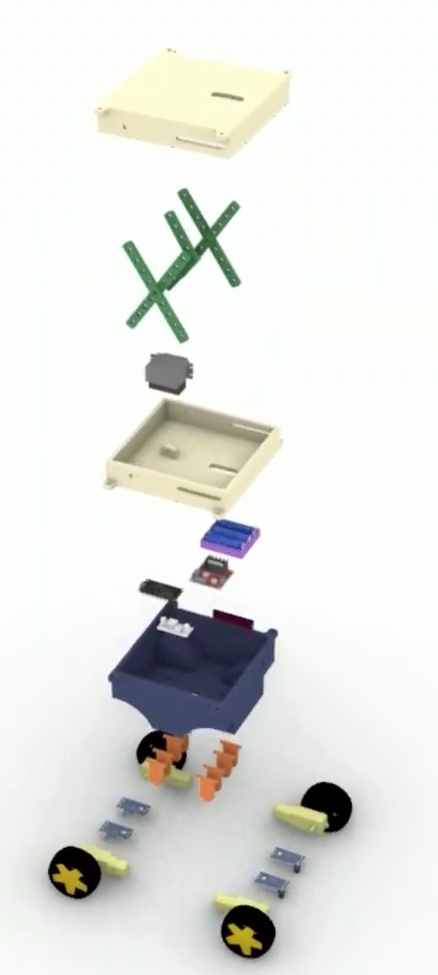
Software stack

A fleet of ESP8266-based robots communicate over MQTT. A Python backend handles route partitioning and coordination between robots, and an Angular dashboard gives real-time control and analytics over the whole fleet.
← Back to all projects